
 POS for Retail
 Sales Hub
 Product Hub
 Inventory Management
 Whatsapp Marketing
 Marketing Automation
 Browser Notification
 Email Marketing
 Fusion Mail
 SMS Marketing
 Fusion SMS
Why Color and Size Variants Should Be Tracked Separately
Learn how variant management helps reduce stock errors, improve e-commerce catalogs, and track product performance more accurately.
Variant management is one of the most common product data challenges for retail and e-commerce businesses. A single product name is rarely enough to represent the complexity of a real product catalog. The same product model can exist in multiple colors, sizes, styles, materials, or packaging options. Each variant may have its own barcode, stock level, sales performance, and sometimes even a different price. When these variants are not managed properly, inventory visibility decreases, reporting becomes less reliable, and operational decisions become more difficult.
As product catalogs grow, variant management becomes increasingly important. Businesses that only track products at the parent level often struggle to understand actual customer demand. While total inventory may appear healthy, the most popular size or color could already be sold out. Without variant-level visibility, businesses risk making inaccurate purchasing, inventory, and merchandising decisions.
Product Hub supports color and size variants through a sub-product structure. This allows each variant to be tracked independently while maintaining its relationship to the main product. For example, a black medium item and a white large item may belong to the same product family, but they require separate inventory records, barcode assignments, and performance tracking. This structure gives businesses greater control over product data while keeping product organization simple and manageable.
The ability to track variants individually is particularly valuable for industries such as fashion, footwear, accessories, cosmetics, and specialty retail, where customer purchasing decisions are often based on specific product attributes rather than the main product itself.
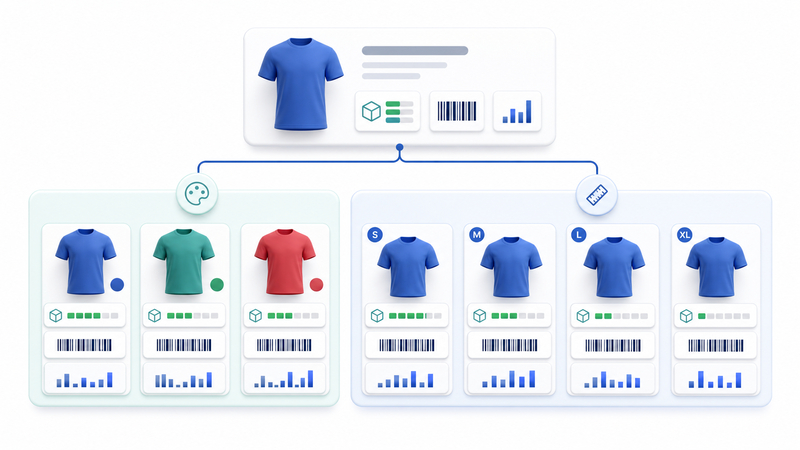
Variant management is especially critical for e-commerce operations. Customers expect accurate visibility into available sizes, colors, and product options. If a variant that is out of stock remains available for purchase, businesses may face order cancellations, customer support issues, delayed fulfillment, and lower customer trust. Maintaining accurate variant availability helps create a smoother buying experience and reduces operational friction.
A centralized product management system helps prevent these issues by keeping variant data directly connected to inventory information. When stock levels change, availability can be updated more accurately across sales channels, reducing the risk of selling unavailable products.
Variant tracking also plays an important role inside physical stores. A product may appear well-stocked when viewed at the parent product level, while the highest-demand variant is no longer available. If store teams only review total stock quantities, they may overlook important inventory signals that affect sales performance.
Variant-level visibility provides deeper operational insight. Businesses can identify which sizes sell fastest, which colors generate the highest demand, and which variants remain in inventory longer than expected. These insights help teams make better decisions about purchasing, replenishment, promotions, and assortment planning.
Reporting also becomes more meaningful when variant data is tracked correctly. Instead of analyzing a product as a single item, businesses can evaluate performance at the individual variant level. This makes it easier to identify demand patterns, understand customer preferences, and improve inventory allocation.
Product Hub makes variant data part of the broader product operation rather than treating it as a separate process. Variant structures, inventory levels, barcodes, pricing models, and sales performance data are all managed within the same platform. This creates a more connected operational environment where teams can access the information they need without relying on disconnected spreadsheets or manual tracking processes.
By centralizing variant management, Product Hub helps businesses improve inventory accuracy, gain deeper visibility into product performance, and create a more scalable approach to managing complex product catalogs. As product assortments grow, having a structured and centralized variant management process becomes essential for maintaining operational efficiency and delivering a better customer experience.