
 POS for Retail
 Sales Hub
 Product Hub
 Inventory Management
 Whatsapp Marketing
 Marketing Automation
 Browser Notification
 Email Marketing
 Fusion Mail
 SMS Marketing
 Fusion SMS
How to Manage E-Commerce Product Data and Multi-Channel Sales
Discover how Product Hub helps businesses manage e-commerce product data, XML imports, and multi-channel sales from a single platform.
E-commerce product data is far more than a product name and price. A product may require descriptions, categories, brand information, images, variants, stock levels, barcodes, pricing structures, channel settings, technical specifications, and other attributes that influence how it is displayed and sold online. When this information is incomplete, outdated, or inconsistent, products can go live late, appear in the wrong categories, display incorrect information, or create a confusing customer experience.
As product catalogs grow, managing this information becomes increasingly complex. E-commerce teams often work with thousands of products across multiple categories and sales channels. Without a structured product data management process, maintaining consistency becomes difficult and operational inefficiencies begin to appear throughout the business.
Product Hub supports e-commerce data management by allowing businesses to define, organize, and maintain e-commerce-specific product information within a centralized platform. Product descriptions, categories, images, variants, pricing structures, and channel settings can be managed alongside inventory and operational records. This helps ensure that product information remains accurate while reducing the need to maintain the same data across multiple systems.
Centralized product data also improves collaboration between departments. E-commerce teams, warehouse operations, purchasing teams, and retail staff can work from the same product records rather than maintaining separate versions of product information. This reduces duplication, minimizes errors, and creates a more consistent operational workflow.
XML product import is particularly valuable for businesses with large or frequently changing product catalogs. Instead of creating products manually one by one, teams can import product information in bulk from XML sources. This significantly reduces catalog creation time and allows businesses to scale product onboarding more efficiently.
However, importing product data is only the first step. Imported information often requires additional organization before it is ready for customers. Products may need to be categorized, enriched with images, assigned variants, linked to brands, connected to inventory records, and prepared for specific sales channels. Product Hub provides a centralized environment where this information can be reviewed, structured, and managed before publication.
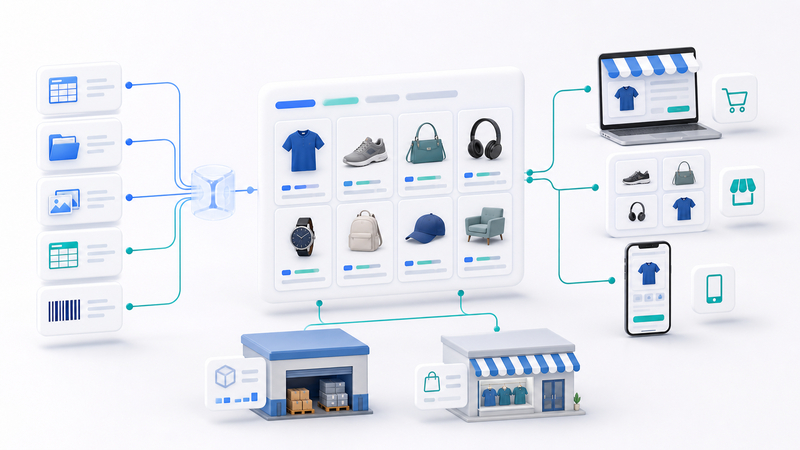
Multi-channel sales management is another important component of modern e-commerce operations. Many businesses no longer sell through a single website. Products may be distributed across company websites, online marketplaces, mobile commerce channels, and other digital sales platforms. Managing product availability across these channels requires careful control of product data, pricing, and inventory.
Product Hub supports multi-channel sales configuration by allowing businesses to determine where individual products should appear. Products can be published to an e-commerce website, Amazon, Etsy, or other marketplace channels according to business rules and channel strategies. This level of control is important because not every product should be available in every channel.
Channel-specific management also helps businesses align inventory and pricing strategies with commercial objectives. A product may have different pricing structures, promotional rules, or inventory allocations depending on where it is sold. By managing these settings from a centralized platform, businesses can maintain greater consistency and reduce operational risk.
As e-commerce operations expand, product data becomes one of the most important assets within the business. Product information influences customer experience, search visibility, marketplace performance, inventory management, and operational efficiency. Poor product data creates friction at every stage of the sales process, while accurate and well-structured product data supports growth.
Product Hub provides a central location where businesses can manage product catalogs, prepare products for multiple sales channels, maintain data consistency, and keep online product information aligned with real inventory. By combining product management, inventory visibility, and channel control in a single platform, Product Hub helps businesses build a more scalable and efficient e-commerce operation.