
 POS for Retail
 Sales Hub
 Product Hub
 Inventory Management
 Whatsapp Marketing
 Marketing Automation
 Browser Notification
 Email Marketing
 Fusion Mail
 SMS Marketing
 Fusion SMS
What Is a Product Management System and Why Do Businesses Need One?
Learn how Product Hub centralizes product details, inventory, pricing, barcodes, QR codes, variants, and sales channels in one platform.
As a business adds more products, the challenge is no longer only selling. The challenge becomes keeping product information accurate, organized, and accessible across different teams and sales channels. A single product can contain dozens of data points, including its name, category, brand, supplier, stock level, price, barcode, QR code, images, variants, and sales channel settings. When that information is spread across spreadsheets, POS systems, warehouse files, and e-commerce platforms, operations become slower, less reliable, and more difficult to scale.
Small product catalogs can often be managed with simple tools for a period of time. However, as product volume grows and operations become more complex, manual processes create bottlenecks. Teams spend time searching for information, updating multiple systems, and correcting inconsistencies. Product data becomes fragmented, making it difficult to maintain a single source of truth across the business.
Product Hub is designed to solve this challenge by bringing product data into one unified platform. Businesses can create products, manage product details, monitor stock levels across locations, assign suppliers, upload images, generate barcodes and QR codes, define variants, and prepare products for both physical and digital sales workflows. Instead of maintaining product information in separate systems, teams work from the same centralized dataset.
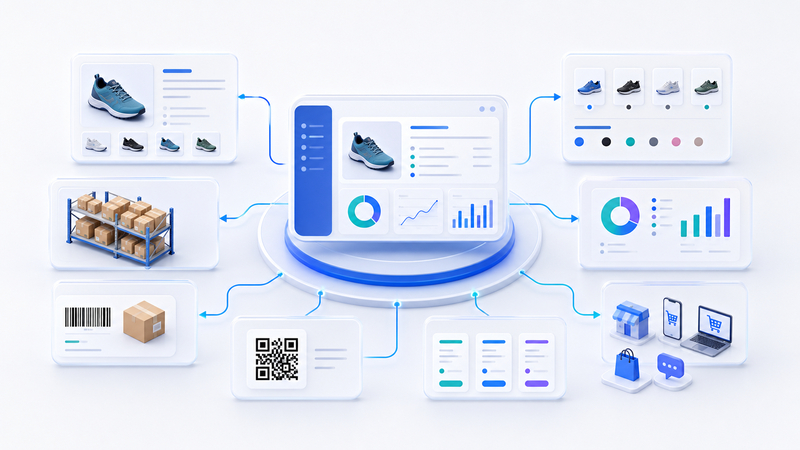 A product management system is far more than a digital catalog. It supports the complete operational life cycle of a product. A product is created, linked to categories and brands, connected to suppliers, assigned color and size variants, given multiple pricing structures, enriched with e-commerce content, and made available across selected sales channels. Managing these processes from a single platform improves consistency, reduces manual work, and helps teams move faster.
The benefits become even more visible as businesses scale. Retailers with multiple stores need visibility into stock by location. E-commerce businesses need accurate product information across websites and marketplaces. Operations teams need reliable inventory data. Finance and management teams need accurate reporting. Without a centralized product management system, each department may rely on different versions of the same product information, creating inefficiencies and unnecessary operational risks.
Product Hub provides a single product truth that can be used across inventory management, pricing, reporting, sales operations, and channel management. When a product is updated, teams can work from the same information rather than maintaining multiple disconnected records. This reduces data duplication, improves operational accuracy, and creates a more reliable foundation for growth.

The platform also supports key operational processes such as barcode management, QR code generation, store-based inventory tracking, variant management, multi-price structures, and sales performance reporting. As a result, businesses gain greater visibility into their products while maintaining control over how product information is distributed and used throughout the organization.
By centralizing product-related information and workflows, Product Hub helps businesses create a more structured and scalable operational environment. Teams spend less time managing data across multiple systems and more time focusing on sales, inventory optimization, and business growth.